Microcredentials are a powerful incentive for learning
Grades no longer motivate students to learn, partly because they lack inherent meaning. As the authority of schools continues to decline, teachers and headteachers are challenged to complement traditional grading systems with alternative, more effective methods of motivating learners. Microcredentials may be one way to do so.
What grades really tell us
‘The traditional grading model is ineffective because grades in themselves have no real meaning,’ says Marcin Szala*, co-founder of Liceum Artes Liberales, an innovative private school focused on experiential learning. The school is known for its original subjects, educational expeditions, and for allowing students to choose extended subjects in line with their interests and talents.
This is not the only critical voice regarding grading systems. In her article ‘What is the problem with assessment?’ Sylwia Żmijewska-Kwiręg argues that two main approaches to assessment can be identified in the discourse. On the one hand, assessment is intended to provide learners with essential feedback on their progress to support further development. On the other, it continues to function as a mechanism for monitoring knowledge levels and for rewarding or penalising learners in an effort to influence motivation.
This raises significant doubts about the effectiveness of the existing grading system, since a six-point grading scale does not provide sufficiently precise information about an individual student.
‘A numerical grading scale is imprecise. What does it actually mean when something is graded as a four?’ asks Marcin Szala.
In theory, teachers should award grades based on clearly defined criteria. In some subjects or for specific tasks, percentage thresholds make this easier. More often, however, it is not possible to define precisely what qualifies for a particular grade. How, for example, can learning outcomes such as the acquisition of soft skills or the development of creativity be described? These are among the future skills increasingly required by employers worldwide.
Grades do not matter
Grades, divided into ‘good’ and ‘bad’, function as tools of reward and punishment, which in theory are intended to motivate students to work.
‘The authority of schools is diminishing, and with it the influence of school-related attributes. The carrot-and-stick approach in the form of good and bad grades no longer works,’ emphasises Marcin Szala.
Students are increasingly aware that obtaining a higher or lower grade has minimal impact on their lives, and that parents are unlikely to impose serious consequences. This is particularly pertinent given long-standing psychological evidence that upbringing based on ‘punishment’ and ‘reward’ does not support healthy child development.
How to encourage students’ continuous development
If grades neither provide sufficient information about what students can actually do nor motivate them to learn, teachers and school officials are faced with the need to supplement existing systems with other ways of communicating progress and encouraging development.
‘One solution is to increase the weight of assessment by linking it to external factors that motivate students,’ argues Marcin Szala.
The key is to ensure that students feel responsible for their own development and have a real influence over how it takes place. At Liceum Artes Liberales, an original assessment system has been introduced. Naturally, the nationally imposed grading scale has not been abandoned; final grades are awarded at the end of the year, and during the term, students also receive percentage results or pass/fail information. However, these elements form only part of the system.
‘The most important component consists of individual student reports. These are detailed, reliable descriptions of what a student has learned during a given period, their attitude, and the knowledge they have acquired. Each report includes in-depth commentary, providing concrete feedback for both students and parents on what has been achieved and what still requires improvement. As a result – and this is crucial – every individual feels noticed,’ explains Marcin Szala.
Microcredentials as part of a motivational system
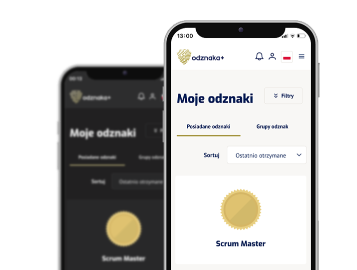
Another important element has been introduced into the Artes Liberales assessment model: microcredentials and digital badges issued via the Odznaka+ application developed by the Educational Research Institute – National Research Institute. Several times a year, students participate in engaging projects that culminate in the awarding of a microcredential. How does this differ from an ordinary grade entered into a register?
‘The key difference lies in communication. Microcredentials and digital badges must be clearly described, with precise criteria for earning them. One of their major advantages is that they can be showcased – for example, shared on social media. As a result, a student’s success extends beyond the school walls, and the school itself becomes a certifying body. Microcredentials have another benefit: they activate a very human factor – collecting. Building a collection of credentials can be highly satisfying,’ explains Marcin Szala.
* Marcin Szala – educational innovator, co-founder of Liceum Artes Liberales in Warsaw, a modern school based on the belief that academic success stems from personal development, and that effective learning can be interdisciplinary and rooted in real-world experience. Expert, author of articles on education, panellist and conference speaker. Formerly programme director at Collegium Wratislaviense, an institution training lecturers and teachers; deputy head and co-creator of the prestigious international Akademeia High School in Warsaw. He teaches and designs curricula in critical thinking and has experience teaching within the Polish Matura Exam, IB and A-level systems. A graduate of the University of Oxford in Physics and Philosophy, scholarship holder of the United World Schools Society. Participant in the Leadership Academy for Poland programme, member of TrendHouse, and fellow of the Salzburg Global Seminar.
Sources: