Modern forms of skills validation – digital badges and microcredentials
Hundreds of millions of digital credentials have already been issued worldwide, and they are increasingly complementing or replacing traditional diplomas and certificates. Digital badges and microcredentials validate specific skills and achievements. Although both solutions serve a similar purpose, there are fundamental differences between them, which is why it is worth understanding their characteristics and how to use them consciously.
Although both forms of skills validation are often mentioned together and their names are sometimes used interchangeably, microcredentials and digital badges are not synonymous. They differ in scope, level of formalisation and the role they play in education and professional development systems. Understanding these differences makes it possible to use the potential of both solutions effectively, from the perspective of individuals building their careers, as well as educational institutions and employers.
Badges – from gaming to digital education
Digital badges are now associated primarily with non-formal education, although they originally emerged from the world of gaming, where they appeared as elements of online gaming platforms. The idea of using them in education was developed by the creators of the Open Badges system at the Mozilla Foundation, inspired by the scouting movement known in the United States and Europe, where badges served as clear proof of specific skills, abilities and achievements of young participants.
In 2012, experts from the Mozilla Foundation described digital badges as a solution supporting skills development and the idea of lifelong learning and professional upskilling. The development of the Open Badges standard was a response to the need for a system capable of recognising and validating non-formal and non-traditional learning experiences, enabling learners to present their skills and achievements in various contexts, such as recruitment processes.
In this sense, badges are primarily characterised by the fact that they:
- are always digital,
- always take a graphical form or include a graphic element,
- can be awarded for various types of achievements, not only educational ones, including:
- competence (demonstrating knowledge, skills and social competences),
- potential (indicators of future achievements),
- participation (e.g. for attending an event),
- membership (confirming affiliation, e.g. to a club),
- engagement (attitudes, values, beliefs),
- motivation (e.g. for good performance).
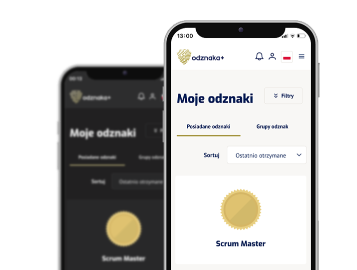
In practice, a digital badge is a graphic file encoded in a specific standard – currently the most popular being the Open Badges 2.0 standard – containing structured information describing a person’s specific competences or outcomes. It can be used for various purposes, for example to confirm participation in a conference, completion of a social project, or to include information about a set of verified learning outcomes held by an individual. The latter brings us closer to microcredentials.
Microcredentials – the weight of quality
Microcredentials, like digital badges, confirm the possession of specific skills. Both forms of credentials provide information about:
- to whom they were issued,
- by whom,
- when,
- for what,
- and what were the issuing criteria (a mandatory requirement for badges and microcredentials issued in the Open Badges standard).
Microcredentials, however, are not the same as digital badges. This is primarily because:
- a microcredential confirms an educational achievement (whereas a badge may relate to various achievements, not only educational ones),
- microcredentials are most often issued in digital form (badges are only digital),
- a microcredential confirms and describes verified learning outcomes,
- a microcredential should be subject to quality assurance,
- microcredentials aim for systemic comparability, recognition and transferability (which is why they usually contain more specific information, such as workload, links to qualification frameworks or skills taxonomies, or they use standardised description models such as the European Learning Model).
Microcredentials and digital badges – clarifying the concepts
Why are the concepts of digital badges and microcredentials so often confused? One of the main reasons is the lack of a single definition that clearly defines what microcredentials are in practice. Different approaches exist worldwide, and individual countries are still refining the scope, meaning and application of this concept.
In Poland, the term ‘microcredentials’ is also only just gaining wider recognition. Its development and wider adoption are supported through initiatives led by the Educational Research Institute – National Research Institute (IBE PIB).
As part of a pilot microcredentials project implemented at IBE PIB, a definition was developed based primarily on the EU Council Recommendation on a European approach to microcredentials for lifelong learning and employability. According to this definition, microcredentials:
- are records of the learning outcomes that a learner has acquired following a small volume of learning in a specific area,
- confirm learning outcomes assessed against transparent and clearly defined criteria by a provider applying quality assurance arrangements,
- are the property of the learner,
- may stand alone or be combined (stacked) into larger credentials,
- may be accumulated and shared, for example in digital form,
- respond to evolving forms of learning and labour market needs,
- confirm skills acquired not only through formal education, but also through non-formal and informal learning, including courses and training,
- are issued by a wide range of providers, including schools, higher education institutions, educational institutions, non-governmental organisations, and sports associations and clubs, based on transparent criteria and quality assurance.
Sources:
- “Open Badges for Lifelong Learning. Exploring an open badge ecosystem to support skill development and lifelong learning for real results such as jobs and advancement,” The Mozilla Foundation and Peer 2 Peer University, in collaboration with The MacArthur Foundation
- Microcredentials, Polish Wikipedia entry: https://pl.wikipedia.org/wiki/Mikropo%C5%9Bwiadczenia
- Council Recommendation of 16 June 2022 on a European approach to micro-credentials for lifelong learning and employability 2022/C 243/02: https://eur-lex.europa.eu/legal-content/PL/TXT/?uri=CELEX:32022H0627%2802%29