A step toward the future. What’s next for the National Microcredentials System?
After three years of work on the microcredentials project at the the Educational Research Institute – National Research Institute (IBE PIB) — the time has come to take stock. The goal is for the conclusions and recommendations gathered so far to serve as a starting point for further action.
The future of microcredentials implementation
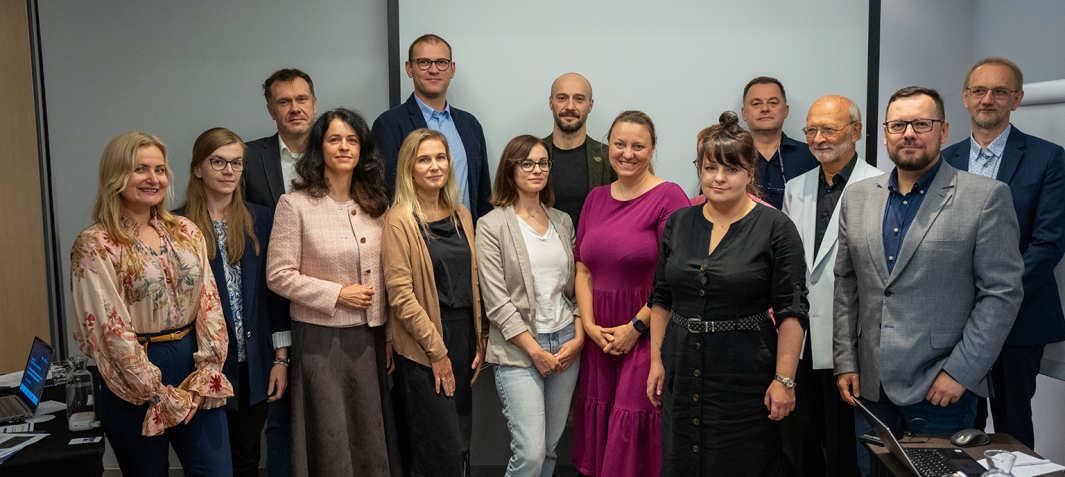
The eleventh meeting of the Microcredentials Advisory Group, held on September 15, 2026, in Warsaw, was devoted to summarizing progress and setting plans for the future. Michał Nowakowski, leader of the microcredentials project at IBE PIB, welcomed the attendees and invited guests representing various institutions to present the current status of their work related to the implementation of microcredentials.
“Microcredentials are an extremely important element in the development of the higher education and science system. The Ministry of Science and Higher Education (MNiSW) is currently working on a legislative solution that will directly address what universities will be able to do with microcredentials,” said Michał Goszczyński of the MNiSW.
Hanna Reczulska from the National Agency for Academic Exchange (NAWA), a new member of the GDM, also spoke, discussing plans to incorporate microcredentials into the agency’s offerings.
“We offer training sessions, courses, and short-term educational programs, which we would like to enhance by offering the opportunity to earn a microcredentials through the Odznaka+ app. The very concept of training that culminates in a microcredentials can be extremely appealing to those seeking educational opportunities,” emphasized Hanna Reczulska.
Odznaka+. New website version and progress
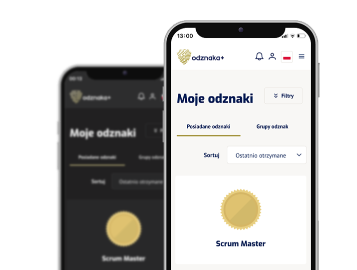
An important part of the Microcredentials Advisory Group’s meetings is a discussion on the progress of work on the Odznaka+ app. This time, Product Owner Grzegorz Tylek focused primarily on the redesign of the app’s website. The new version of the website, accessible before logging in, is much more user-friendly, clear, and modern. It contains the most important information for all user groups.
Group members also learned about recent updates to the application, including the launch of the full version of the mobile app for both users and certificate issuers, the addition of the ability to create PDF certificates, and the implementation of additional security measures within the application. Grzegorz Tylek also announced the next steps to be taken, including the launch of the certificate browser within the application in November 2026. Dr. Wojciech Gola, a key expert on the microcredentials project, summarized this section:
“We are constantly discussing quality assurance, as it is a crucial element of the system we are building. We must ensure that microcredentials are credible and that recipients trust that they guarantee the competencies for which they were awarded. Therefore, technology is key here—enabling the issuance of microcredentials in various standards recognized worldwide.”
Odznaka+. Microcredentials offerings and a pilot program for publisher accreditation
Next, Dr. Wojciech Gola presented to the audience the micro-credentials developed during the first three years of the project. By the end of August 2026, 240 microcredentials had been created in the Odznaka+ app, and as many as 10,000 had been issued to individual users. A total of 56 issuers have joined the system and are already issuing microcredentials.
“A large number of issuers are universities, but there are also entities among us involved in training, courses, and providing educational programs, including in non-formal settings,” explained Dr. Wojciech Gola, continuing:
An analysis of the microcredentials available in our system shows just how diverse they are. The certificates have different names, vary in terms of the level of complexity of the competencies they validate, and differ in the amount of work required to earn a given microcredentials. This diversity demonstrates that the system we are creating is flexible and responds to the needs of various issuers, various recipients, and various learners. It enhances and makes more attractive the offerings of higher education institutions, training companies, providers of professional development services, as well as employers who prioritize the development of their employees’ competencies.
Following a fruitful discussion on the microcredentials offerings within the National System currently under development, members of the Advisory Group listened to a presentation by Dr. Wojciech Stęchły, an expert from IBE PIB, who reported on the status of work on the progress of work regarding system’s design. The attendees were briefed, among other things, on the creation of a draft version of the course for system issuers and on the next steps regarding the pilot accreditation of issuers.
Microcredentials – recommendations for the future
The final part of the meeting was devoted to a discussion of recommendations regarding the implementation of micro-credentials in Poland, the development of which is one of the most important objectives of the IBE PIB project. Dr. Wojciech Gola discussed the key areas of the recommendations concerning possible solutions for the practical operation of microcredentials and national education policy.
The IBE PIB expert also presented plans for the project’s key development activities.
“Soon, our microcertification offerings will be more visible to every app user. They will be able to find and review each microcertification in the browser, allowing them to choose the one that best meets their needs. We also plan to conduct further quality assurance testing and pursue accreditation for our issuers. In addition, we will begin collaborating with secondary schools. We will continue to discuss how to implement microcredentials on a systemic level,” concluded Dr. Wojciech Gola.
The meeting was attended by:
Agnieszka Dec, Ministry of Funds and Regional Policy
Michał Goszczyński, Ministry of Science and Higher Education
Prof. Andrzej Kraśniewski, Ph.D., Conference of Rectors of Polish Academic Schools
Małgorzata Lelińska, Lewiatan Confederation
Paulina Noińska-Rozentalska, Ministry of Family, Labor, and Social Policy
Hanna Reczulska, National Agency for Academic Exchange
Bartosz Siemiątkowski, Ministry of Funds and Regional Policy
Aleksandra Wąsik, All-Poland Alliance of Trade Unions / Polish Teachers’ Union
Katarzyna Mucha, Information Processing Center – National Research Institute