Skills instead of beaten paths. Conversations about work and learning in a world of dynamic change
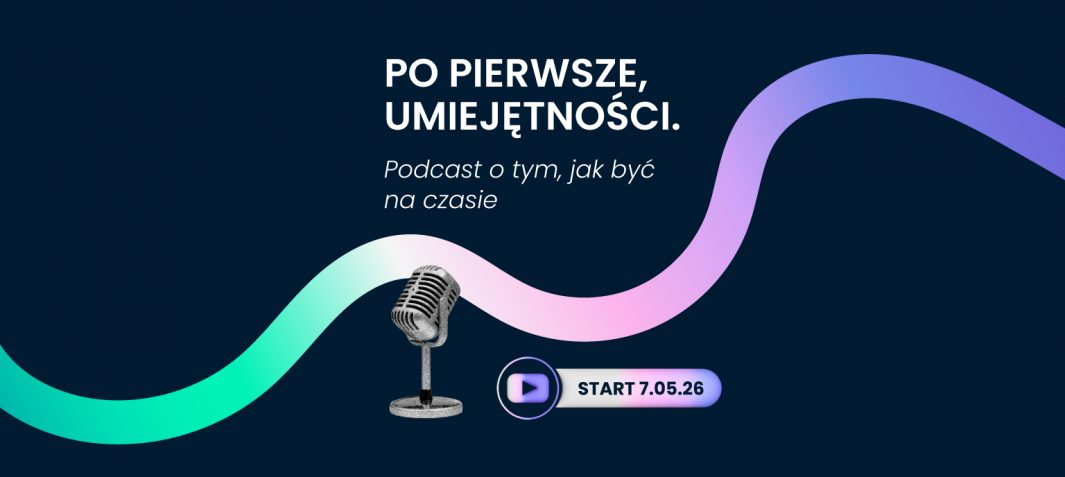
Go to podcastsAleksandra Przegalińska, Maciej Kawecki, Ewa Woydyłło, Tomasz Stawiszyński – these are just a few of the exceptional guests you will soon be able to hear and see, starting from 7th May 2026, in the podcast by the Educational Research Institute – National Research Institute: „Po pierwsze, umiejętności. Podcast o tym, jak być na czasie” (Skills Come First. The Podcast About How to Stay Current).
When the labour market outpaces education
Artificial intelligence is changing the way we work faster than the education system can keep up. Degrees are increasingly failing to keep pace with the market, and competences are becoming outdated at a rate that was unimaginable until recently. That is why this podcast asks how to learn mindfully, responding to employers’ needs without compromising one’s own values. These conversations explore skills, education, and work as a continuous learning process, where microcredentials – flexible ways of validating specific skills that better fit the pace of market changes – play an ever-greater role.
Different perspectives, one common conclusion
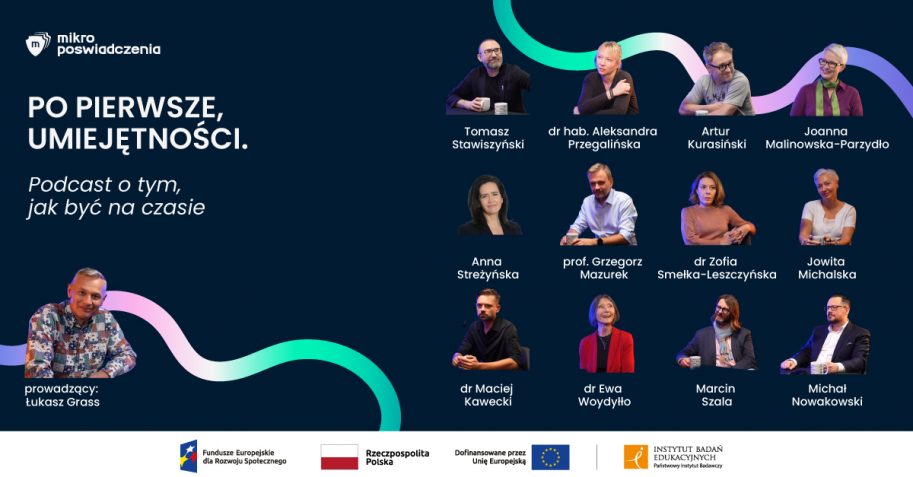
Experts who view education and development from various perspectives – technological, psychological, philosophical, market-based, and systemic – have been invited to share their insights. The podcast guests include: Tomasz Stawiszyński, Dr hab. Aleksandra Przegalińska, Artur Kurasiński, Joanna Malinowska-Parzydło, Dr Maciej Kawecki, Grzegorz Mazurek, Dr Ewa Woydyłło, Jowita Michalska, Dr Zofia Smełka-Leszczyńska, Anna Streżyńska, Marcin Szala and Michał Nowakowski.
Their contributions form a coherent narrative about a world where formal education is no longer enough. Instead, specific, proven skills and a readiness to constantly update them are becoming paramount. In the labour market, what we can actually do is more important than a university degree, and recruiters are increasingly putting this to the test. This aspect also recurs in discussions about technology and AI. Experts encourage us to delegate certain tasks to AI tools while consciously investing time in developing the skills that technology cannot replicate – those that build our competitive advantage today. These include critical thinking, assessing information quality, and the ability to connect knowledge from different fields.
Microcredentials as the ‘currency’ of skills
In this context, the role of microcredentials emerges ever more clearly as a way of organising conscious lifelong learning. They do not replace formal education but complement it, allowing individuals to build competences in stages, at a pace that fits their professional lives.
“Microcredentials are the ‘currency’ of skills – they validate not only the result but also the journey, the quality, and the purpose of the acquired competence,” says Michał Nowakowski, project leader at the Educational Research Institute – National Research Institute for “Microcredentials – Piloting a New Solution To Support Lifelong Learning.”
It is this flexibility that makes microcredentials an increasingly effective response to the dynamics of the labour market, while allowing people to manage their own long-term development rather than simply reacting to the next crisis or change.
Conversations that resonate
The podcast series “Skills Come First. The Podcast About How to Stay Current” is hosted by Łukasz Grass, a television and radio journalist. Episodes will be released weekly on the IBE YouTube channel and Spotify.
The podcasts were conducted as part of the project “Microcredentials – Piloting a New Solution To Support Lifelong Learning,” funded by the European Funds for Social Development (FERS) programme. #EUFunds