The National Centre for Research and Development (NCBR) call for proposals for higher education institutions. One of the solutions – a microcredentials system developed at IBE PIB
The voices of labour market representatives, students and experts, as well as recommendations from the European Union, all point in the same direction: higher education institutions must adapt their educational offerings to the changing socio-economic environment and to the needs of learners and their future employers. One of the key expectations placed on higher education is the introduction of shorter, more focused forms of learning that enable the acquisition of knowledge and skills, together with reliable methods for recognising and certifying these achievements. This is precisely where the role of microcredentials in higher education begins.
Universities modernise their offer
Nowadays, the debate surrounding the role of higher education does not lead to straightforward conclusions. Some argue that university studies are no longer necessary and that degrees are losing their value. On the other hand, many people still believe that completing a degree in a particular field provides an essential foundation for securing their desired job and achieving professional success.
These contrasting opinions appear to be moderated by a position that is consistent with European Union recommendations: higher education is still important, but universities must adapt their educational offer to the demands of the modern world, the evolving labour market, and the expectations of lifelong learners.
Support for higher education institutions
Among the challenges facing universities is the need to embrace new approaches to learning and study, respond to the needs of learners outside the traditional student age group, and address student dropout, where students leave their studies in favour of entering the labour market.
The academic community can count on support from the European Union. Applications are open until 29 June 2026 for the “Uczenie się przez całe życie – rozwój oferty uczelni” (Lifelong Learning – Expanding University Portfolios) call for proposals – organised by the National Centre for Research and Development (NCBR) and supported by the European Funds for Social Development (FERS). The call is aimed at higher education institutions that will design projects focused on FERS objectives related to aligning qualifications and competences of the adults with the needs and expectations of employers and the labour market.
During the meeting about the call, Martyna Kozłowska-Żukowska, leader of the „Universities of the Future” project at NCBR, noted that higher education institutions wishing to participate have access to tools that support the expansion of their academic offerings to include modern forms of skills validation. These are, first and foremost, microcredentials. Higher education institutions may choose to develop their own systems for issuing credentials that certify acquired competences, or they can make use of solutions that are already operating successfully in the market. One such option is the national microcredential system, currently being developed by the Educational Research Institute – National Research Institute (IBE PIB).
National microcredential system – public and free
The microcredential system developed by the IBE PIB experts provides support for Polish higher education institutions. The Institute is currently running a pilot scheme involving 35 higher education institutions, with more continuing to join. Interest in this solution stems partly from the fact that it is built in strict alignment with European Council recommendations. This applies not only to its technological framework but also to its quality assurance standards and the core principles governing how microcredentials are designed and issued.
Moreover, the IBE PIB microcredential system is public and completely free. Its objective is not only to develop an application or standards for the issuance of microcredentials, but also to test the solutions created in preparation for the systematic implementation of microcredentials within the country’s educational policy and practice.
Odznaka+. Application of the future
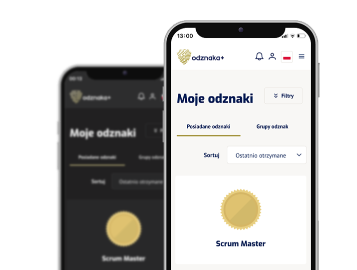
The project includes the ongoing development and improvement of Odznaka+, an application designed for the issuance and storage of microcredentials and digital badges. Its creators aim to ensure that the microcredentials generated through the platform are consistent, durable and interoperable, enabling them to be recognised and used by their holders not only within the issuing institution, such as a university, but also across different organisations and countries worldwide. In addition, the project team is finalising integration with the Moodle learning management system and has begun work on integration with USOS.
Moreover, the application enables building complex learning pathways based on various types of credentials via a user-friendly drag-and-drop interface. A catalogue of microcredentials, together with a map, digital badges, learning opportunities and development pathways, will be made available to users in September 2026. Over the coming months, users will also gain access to a personal profile enabling them to build their own skills maps, as well as advanced identity verification features that combine cryptographic identity credentials with data from Poland’s national digital identity infrastructure, including mObywatel and the Trusted Profile (Profil Zaufany).
The Odznaka+ application is designed as a system-level solution, ensuring its long-term sustainability and continued availability to users beyond the lifetime of the project. Additionally, the solution being developed by the IBE PIB is the only one currently available on the market to offer full interoperability with the two most widely used standards for verifiable credentials: Open Badges 3.0 and European Digital Credentials (EDC). The Open Badges standard has already been implemented, while the EDC solution is technically complete and undergoing final testing. The process of contracting a provider of qualified electronic seals for signing microcredentials issued in the EDC format has also been initiated. The Institute will ensure that every participating institution is able to sign its microcredentials with a qualified electronic seal free of charge.
Five institutions participating in the pilot are currently testing a public API (Application Programming Interface), which enables data exchange between different software systems. The public API will be made available to partners from July 2026.
For higher education institutions wishing to apply for funding, this represents a significant advantage: a ready-made, free-of-charge tool that enables them to issue credentials for short, focused learning experiences. In addition, universities that join the pilot programme run by the IBE – PIB can benefit from both technical and substantive support from experts, working collaboratively to develop the best possible offer aligned with the principles of lifelong learning.
Link to the webpage where higher education institutions can submit an application: https://www.gov.pl/web/ncbr/uczenie-sie-przez-cale-zycie-rozwoj-oferty-uczelni
This article has been prepared as part of the project “Microcredentials – A Pilot Project for Supporting Lifelong Learning” funded by the European Funds for Social Development (FERS).