Don’t expect the world to stay the same. Experts discuss the future of work and education
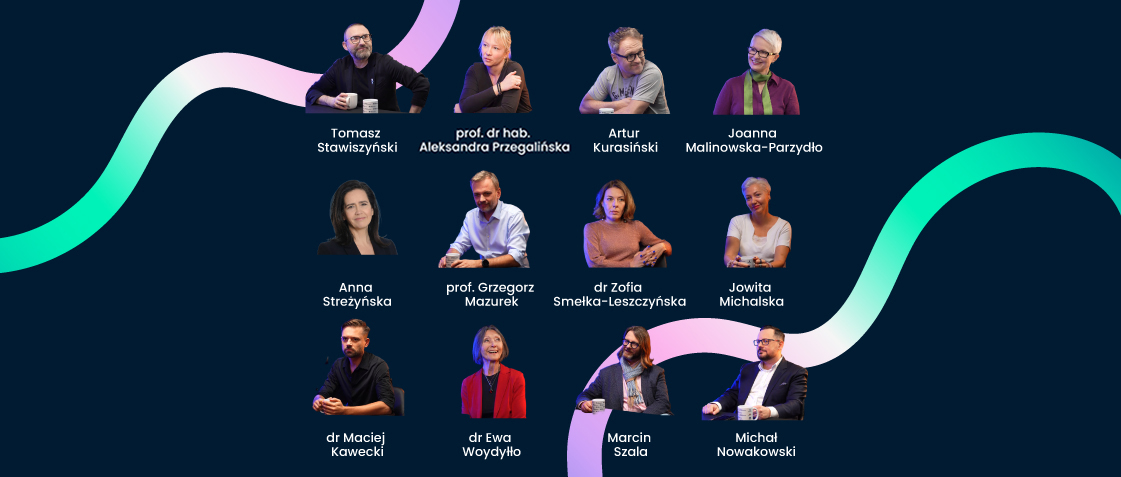
We shouldn’t expect the world to remain as we know it – this is a view shared by, among others, Prof. Aleksandra Przegalińska, Dr Maciej Kawecki, Dr Ewa Woydyłło We shouldn’t expect the world to remain as we know it – this is a view shared by, among others, Prof. Aleksandra Przegalińska, Dr Maciej Kawecki, Jowita Michalska and Tomasz Stawiszyński. In a podcast produced by the Educational Research Institute – National Research Institute (IBE PIB), “Po pierwsze, umiejętności. Podcast o tym, jak być na czasie” (Skills Come First. The Podcast About How to Stay Current), experts discuss which competences are regarded as the skills of the future and how to consciously shape your education and career path.
Tomasz Stawiszyński. In a podcast produced by the Educational Research Institute – National Research Institute (IBE PIB), “Po pierwsze, umiejętności. Podcast o tym, jak być na czasie” (Skills Come First. The Podcast About How to Stay Current), experts discuss which competences are regarded as the skills of the future and how to consciously shape your education and career path.
One of IBE PIB’s key areas of activity is promoting the idea of lifelong learning. This commitment is reflected in the Institute’s microcredentials project, which focuses on solutions for education and the labour market. As part of the project, the Institute invited leading experts in science, technology, employment and education to discuss the competences of the future. The result is the original podcast series “Po pierwsze, umiejętności. Podcast o tym, jak być na czasie.”
Labour market – 40% of employees’ skills will need updating
Current labour market forecasts point to the rapid pace at which employees’ core skills are becoming outdated. According to the World Economic Forum’s “Future of Jobs Report 2025” nearly 40% of existing skills will change by 2030. They will need to be updated, expanded or replaced with new ones. In practice, this means a shift from a model based on “having knowledge” to one based on “being ready to learn continuously.”
“Technological skills become outdated every two and a half years. Soft skills lose their value every five years. We all need to develop a new approach to learning,” explains Jowita Michalska, founder and CEO of Digital University.
The types of skills that employers value are also changing. Among the most important are collaboration skills, not only within traditional teams but also in large, interdisciplinary groups, and alongside AI tools.
Joanna Malinowska-Parzydło, HR expert with extensive industry experience, emphasises that practical work experience continues to be highly valued. She encourages people entering the labour market to apply their knowledge in practice as early as possible. She also highlights the growing importance of social and interpersonal skills.
Changes in the catalogue of skills valued by the labour market, and in the ways those skills are acquired, will lead to changes in how they are recognised and verified. Dr Zofia Smełka-Leszczyńska, a cultural anthropologist, psychologist and author of the book “Cześć pracy. O kulturze zap***dolu”, explains:
“You have to wait three or five years for a university degree. Yet what can happen in the first three years of our careers may be far more dynamic, thanks to skills acquired and certified in much shorter cycles than those culminating in a degree. Microcredentials give people the sense that they can build their professional identity through small, gradual steps.”
The growing importance of microcredentials in the labour market is also highlighted by Anna Streżyńska, Director of the National Institute of Telecommunications – National Research Institute:
“Job applicants will no longer bring a paper CV to an interview – it will be stored in the cloud. They’ll simply send the employer a link, and the employer will run an AI system that says: yes, this candidate is highly desirable because, among their many microcredentials, six are particularly valuable to us and make them the best possible fit for this specific role.”
Mental wellbeing should also be a key priority for people throughout their careers. Dr Ewa Woydyłło, psychologist and addiction therapist, points to the widespread problem of occupational burnout and offers practical advice on how to prevent it.
“Sometimes it is enough to reduce your workload. In other cases, changing the type of work you do – perhaps your profession or role – may prove more effective. It is also worth remembering that, over time, not only do we change as individuals, but so do the things that give us satisfaction.”
Education: is the era of higher education coming to an end?
The unprecedented pace of technological development is driving major changes in education. Learning must adapt to the expectations, needs and opportunities of today’s learners, and ultimately to the evolving demands of the labour market.
Opinions on the future of higher education are sharply divided. Some predict the end of the traditional university model, while others argue that demand for higher education will remain stronger than ever.
“The era of higher education is coming to an end. You no longer need a university degree to build a successful career – you need talent and the ability to develop it. That has been the reality in Silicon Valley for years. Half of my team never graduated from university, yet they are exceptionally talented young people,” says Dr Maciej Kawecki, president of the Lem Institute, director of the WSB Merito Innovation Centre and science journalist.
Professor Grzegorz Mazurek, rector of Kozminski University, takes a different view.
“I see universities primarily as places for personal development, where acquiring knowledge is only one part of the much broader value that studying offers.”
Professor Aleksandra Przegalińska, vice-rector for Innovation at Kozminski University, believes that increasing numbers of young people will choose to complete a bachelor’s degree without progressing directly to a master’s programme. They will then enter employment while continuing to develop their skills through lifelong learning. This will require fundamental changes in both teaching and assessment.
“Degree programmes need to become more personalised. Artificial intelligence and microcredentials are extremely promising tools that can make every student’s learning journey unique,” she explains.
Secondary schools also face significant challenges. One of the greatest is motivating young people to learn in a world full of distractions that often appear more attractive than education itself.
“A school that tries to compete with Netflix is bound to lose. Modern schools need to completely rethink the role of students – they cannot simply be passive recipients of knowledge. They must actively participate in the learning process and be genuinely engaged,” says Marcin Szala, co-founder and a director of Warsaw’s Artes Liberales Secondary School.
Skills of the future
The experts also identify the competences that will be essential in a world shaped by rapid technological change. These skills matter at every stage of life, from children acquiring foundational knowledge, to those entering the labour market, to experienced professionals.
Tomasz Stawiszyński, philosopher, essayist, columnist and author, highlights the growing shortage of skills such as reading comprehension, critical and analytical thinking, and the ability to construct coherent arguments.
“Where analytical, independent and critical thinking declines, people become increasingly vulnerable to propaganda, persuasion and political or marketing influence based primarily on emotional messaging,” he explains.
Artur Kurasiński, entrepreneur and investor, focuses on another challenge: the endless stream of information produced and shared online by virtually anyone, making reliability increasingly difficult to assess. He argues that education should place much greater emphasis on teaching people how to evaluate information and identify trustworthy sources.
“As the saying goes – trust, but verify. Simply check things,” he concludes.
Microcredentials – the new currency of skills
One response to the changing labour market and the evolving expectations of learners is the growing popularity of microcredentials across Europe and the United States.
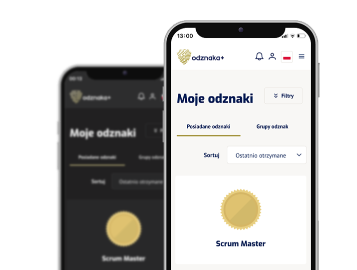
“A microcredential is a digital certificate of skills, but one whose quality has been assured. It contains clear information about what an individual had to do to earn it, as well as who issued it and when,” explains Michał Nowakowski, microcredentials project leader at the Educational Research Institute – National Research Institute (IBE PIB).
The microcredentials ecosystem brings together organisations that issue credentials recognising the skills acquired by their learners or employees, as well as individuals who use them. Issuing organisations include training providers, universities, schools, non-governmental organisations, public employment services and cultural institutions. Any individual can become a user of the system, for example, by building a digital portfolio of their skills and qualifications and sharing it with employers.
Listen to the full interviews now on microcredentials.pl, YouTube and Spotify.
The podcast “Po pierwsze, umiejętności. Podcast o tym, jak być na czasie” is produced as part of the project “Microcredentials – Piloting a New Solution To Support Lifelong Learning” funded by the European Funds for Social Development (FERS).